Overview
Edge AI needs high-resolution video, and 5G links fight path loss, multipath fading, and noise the whole way. This project quantifies how those physical-layer impairments actually affect a modern detector. We built the transmit/receive chain in Python — QPSK modulation, OFDM with cyclic prefix, SVD-based beamforming over a 64×4 antenna configuration, and Rayleigh / 3GPP Urban-Micro channel models — and accelerated the matrix-heavy parts with CuPy so the whole pipeline runs in real time on one GPU alongside the detector.
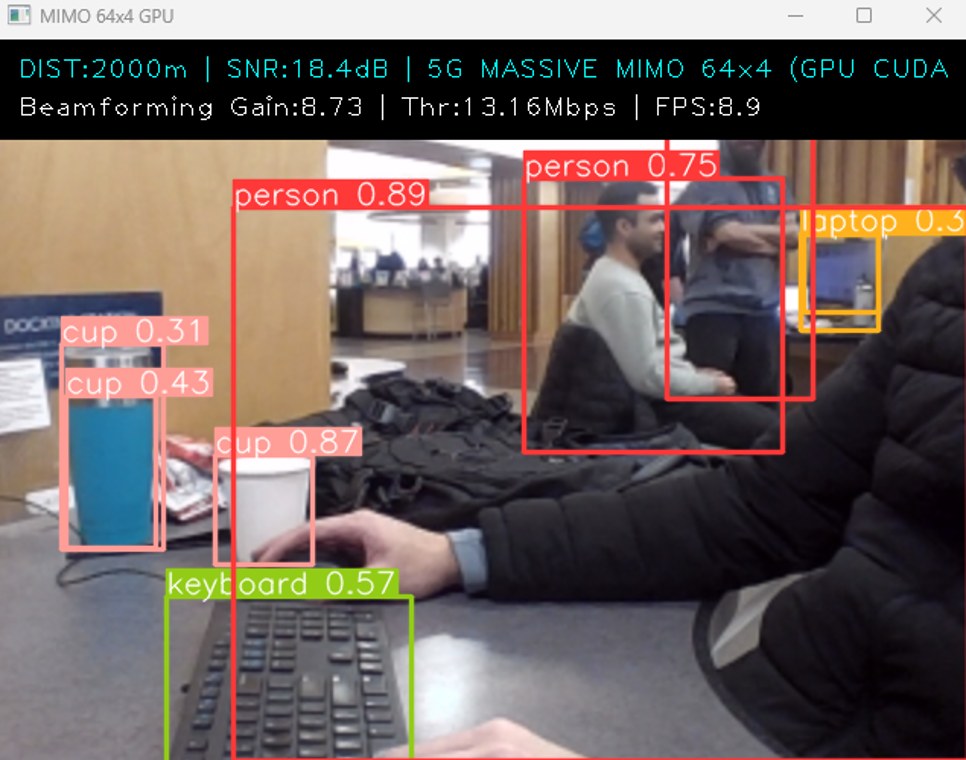
Live webcam frames are compressed adaptively based on the instantaneous SNR, pushed through the simulated channel, reconstructed, and handed to YOLOv10 — chosen for its NMS-free, low-latency design. The result is a live demo where you can watch detection confidence respond as simulated distance and channel conditions change, from a clean SISO baseline out to a 50 km massive-MIMO downlink.
Highlights
- End-to-end 5G NR PHY in Python: QPSK, OFDM + cyclic prefix, SVD precoding/combining, AWGN and Rayleigh fading.
- 64×4 massive-MIMO beamforming sustains detection at simulated distances where the SISO link collapses.
- CuPy GPU acceleration keeps the PHY simulation and YOLOv10 inference running concurrently in real time.
- SNR-adaptive video compression trades resolution for robustness as the channel degrades.